
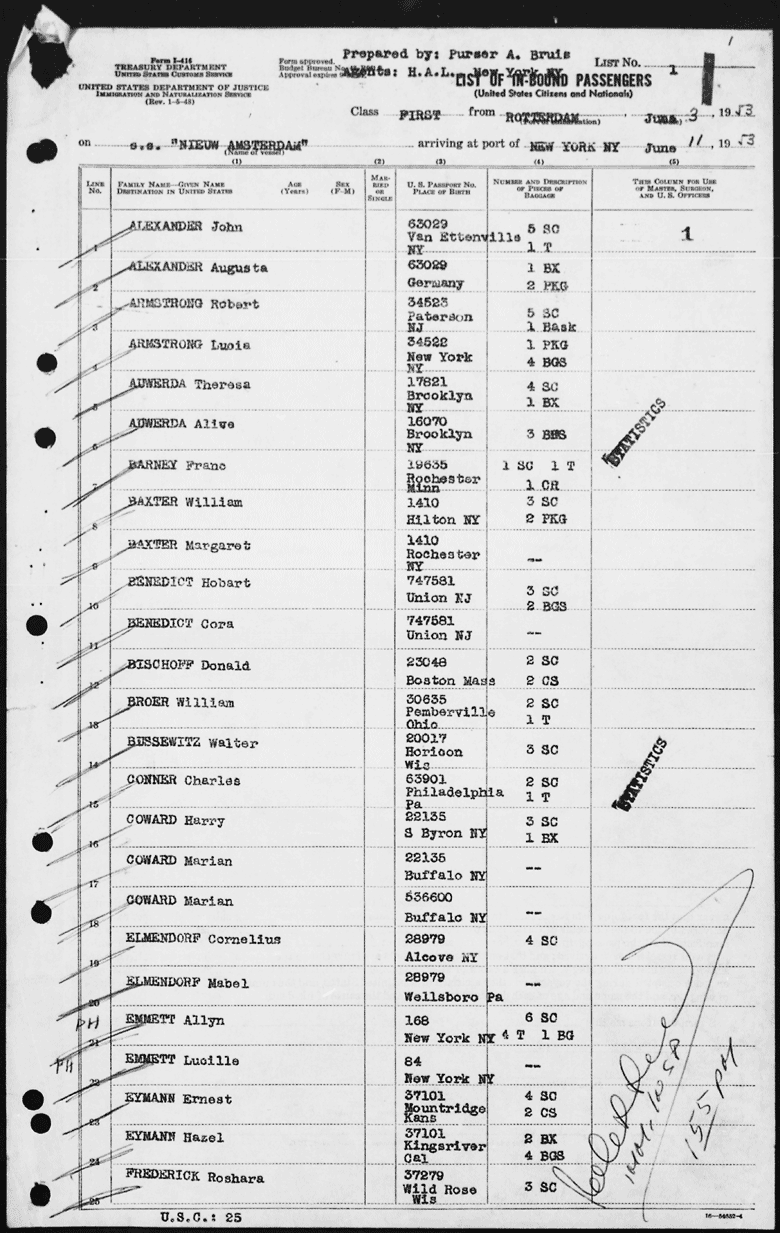
Passenger Arrival Record (NATF 81)
Fee (includes shipping & handling): $20.00
Reproductions for inbound Federal passenger arrival records for ships and airplanes (1820-1959).
What reproduction quality can I expect if I select CD/DVD or Electronic Transfer as my delivery method?
All NARA reproductions contain the best available images of the original archival documents. Due to age, physical deterioration and equipment available at the time the original documents were imaged, some images may not be up to today’s standards of clarity. NARA makes every effort to provide customers a clear and accurate duplicate of the original microfilm master.
How long will an Electronic Transfer be available?
Files will be available for 30 days from date of upload; downloads of the files should take place within that period. Files will be deleted after that point.
What is a passenger arrival record?
The passenger arrival record is the manifest (list) showing the persons arriving in a U.S. port of entry on board a ship, airplane, or train from Canada. Some arrivals across the border with Mexico happened on foot, and in those cases, a card manifest was created.
Why are they called passenger arrival records and not immigration lists?
Not everyone arriving in the United States was an immigrant. The lists include tourists, diplomats, students, and US citizens. At the height of immigration in 1907, 1,285,349 aliens immigrated to the United States while roughly twice that many names are on the lists for the same year.
What passenger arrival records do you have?
The National Archives and Records Administration (NARA) has immigration records for various ports for the years 1800-1959. Please see Ship Passenger Arrival Records main page for further information.
What are the indexes to passenger arrival records?
These are the finding aids which help us locate a specific passenger or family among all of the passenger lists in our custody. Many of the indexes were originally created by the Works Progress Administration (WPA) during the 1930s. Some of them are alphabetical but many of them use a coding system called Soundex. Soundex was also used for the US census records. The indexes were designed to capture information about immigrants. For that reason, they generally only index vessels which carried immigrants or portions of vessels where immigrants were most likely to be housed. In many cases they index only passengers traveling alone or the head of household. After 1897 they only indexed steerage passengers. There are large segments of the passenger arrival records for which there are no indexes.
What information do you need to search for a passenger arrival?
If there is an index, we need the following information: (1) name and age of passenger (2) port of entry (3) year of arrival
If there is no index, we need the following information: (1) port of entry (2) the name of the vessel (3) exact date of arrival (4) the name and age of the passenger
or (1) port of embarkation (2) exact date of arrival (3) port of entry (4) the name and age of passenger
What is a port of entry?
The port of entry is the location of the office that collected the records. For many years the port of entry for arrivals through Canada was St. Albans, VT. That is where the records were kept and that is the port that is searched.
What is a port of embarkation?
The port of embarkation is the port where the passenger boarded the ship. It is not the name of the village where he or she lived.
What will I get if I order a passenger list?
We will send you a copy of the manifest (list) showing the person or family you request. The passenger lists are all on microfilm. Some of the records were transferred to the National Archives on microfilm. The paper records were destroyed long before we ever received the microfilm. That means that errors, omissions, and poor image quality cannot be corrected.
What about people who immigrated through Canada or Mexico?
Many of the border crossing records are recorded on manifest cards. All of the information usually found on the passenger list is recorded on the Immigration Form 548.
Where do you find a record of a birth or death occurring on vessels or aircraft on high seas?
When a birth or death occurs on the high seas, whether in an aircraft or on a vessel, the record is usually filed at the next port of entry.
I found my ancestor on an index card that reads CR#96534. What does CR#96534 mean?
The CR# means that a certificate had been issued because the person was not listed on a passenger manifest in the typical way. You will need to request information from the United States Citizenship and Immigration Services (USCIS). You will need to complete USCIS Form G-639 (Application for verification of information from the Immigration and Naturalization Service records), available online or by writing to:
USCIS 26 Federal Plaza New York, NY 10278
If you need a USCIS file dated before March 31, 1956, you should send your Freedom of Information/ Privacy Act (FOIA/PA) request on a form G-639 to:
USCIS Headquarters FOIA/PA 425 I Street, NW Washington, DC 20536
I found my ancestor on a passenger manifest but some of the information is in some kind of code. What do the numbers and codes mean?
The historian of the United States Citizenship and Immigration Service (USCIS) has written an informative article on “Manifest Markings: A Guide to Interpreting Passenger List Annotations”. This article answers many questions regarding the interpretation of the information that you may find on passenger manifests.
I know that my ancestor arrived in New York between 1847 and 1896 but I don’t know the name of the vessel or the exact date. What can I do?
The New York passenger lists in our custody are not indexed for the years 1847 through 1896. We are unable to provide a page by page search of these extensive lists unless you can provide the name of the ship and the specific date of arrival. You may be able to locate this information in a naturalization file or in a privately published index. Consult your librarian for information about access to some of these books, CD ROMs, and subscription services.
How can I get a naturalization file for my ancestor?
On March 26, 1790, Congress passed an act (1 Stat. 103) that allowed any individual seeking citizenship to apply to any court of record in a state where he or she lived for one year. Before September 27, 1906, an alien could seek citizenship through any Federal, state, or local court.
As a result, you need to know to which court your subject submitted the application for naturalization. If he or she were naturalized in a state or local court, you will need to contact the court directly to obtain information regarding the disposition of its records. Records of naturalization proceedings in Federal courts are usually among the records of the U.S. District Court in which the proceedings took place. These records may still be in the custody of the court, or they may have been transferred to one of the regional branches of the National Archives as a part of the Records of the District Courts of the United States (Record Group 21).
After 1906, the Immigration and Naturalization Service (INS) collected a copy of each certificate of Naturalization issued. For information regarding naturalizations occurring after 1906, which are called certificate or “C” files, you should contact the INS.
To request information from the INS you will need to complete INS Form G-639 (Application for verification of information from the Immigration and Naturalization Service records), available online or by writing to:
INS 26 Federal Plaza New York, NY 10278
INS will charge a fee to complete your request. If you need an INS C File dated 1906 to March 31, 1956, you should send your Freedom of Information/ Privacy Act (FOIA/PA) request on a form G-639 to the INS Headquarters FOIA/PA in Washington, DC.
Are there any indexes available on other websites that would fill the gap in the New York indexes?
The National Archives, the National Park Service and the Ellis Island/Liberty Island Foundation were all partners in developing an online index to the records of arrivals in New York during the Ellis Island period (1892-1924). This fills the gap between 1892 and 1896. It is free and available at https://www.ellisislandrecords.org.
I am looking for an immigration record for my Chinese ancestor. What records do you have?
You will find a complete description of the type of records that are available at https://www.archives.gov/research/genealogyheritage/chinese-immigration.html.
Specifications
Fulfillment
- Usually ships in
- 60 - 90 calendar days